
Opened CC-2148 for the sterilization hold time.
Linked to SOP-118 Rev C · PLM ECO-441
Solutions · Change Control
The change gets approved.Nobody can replay why.
Sign-off happens in email threads and design reviews, so the evidence that was seen and the conditions that were accepted never reach the record. Unifize holds the change itself, from the request to the effective date.
Start the change from home: a title, an owner, the people it needs
Runs wherever a revision has to be proven
If it changes a released product, it has a home here.
The change work engineering and quality actually run, as governed workflows: named approvers, evidence bound to the revision, an effective date the floor and the supplier both see.
The change itself
Somebody asks for a change, the right functions weigh in, it goes live for good.
- Change Control
- Engineering Change Order Governance
What a revision touches
The specifications a change rewrites, and everything downstream that has to move with them.
- Raw Material and Component Specification Management
- Packaging Specification Management
Change you did not start
The revisions that arrive from a customer or a supplier, on their schedule.
- Customer Specification and Contract Change
- Product Lifecycle and Obsolescence Management
The change is approved. The line never hears.
The failure modes we see inside change control. None of them is a missing feature. All of them are decisions that happened off the record.
- Change effectivity not propagated to the production line before parts shipApproved on time. The line still builds to the old revision.
- Change impact assessment skips the affected persona setEngineering and Quality sign. Training and Field Service find out later.
- Late training cascade after change closurePeople work to the new version for weeks, untrained.
- Low-risk changes inherit high-risk approval depthA typo in an SOP waits in the same queue as a design change.
Parts built to a revision that was already superseded. That rework is the coordination tax.
Measure your coordination tax →Run the change where the sign-off happens.
Most systems record that a change was approved. Unifize holds the review itself, so the evidence seen, the conditions accepted and the effective date seal into a trace an auditor can replay.
The modules that run the change.
Change Control ships inside the Document Management System, next to the documents and training every revision moves. The product record it rewrites lives in Product Lifecycle Management.
- Explore the product →
Document Management System
The change backbone: request, impact, approval and the revision it publishes, on one governed record.
Product Lifecycle Management
The product record a change rewrites: specifications, design traceability, risk and control plans.
- Product Specifications
- Design Controls & Traceability
- Product Risk Management
- FMEA & Control Plan Definition
It sits on the stack you already run.
Keep the PLM, ERP and MES that hold your BoMs, routings and released documents. Unifize runs the review around them, and the approved change goes back with a 21 CFR Part 11 signature. No rip-and-replace, and no revalidation of a system that already passed.
Proof, to the standard you'd hold us to.
A signed baseline, not a brochure stat, plus the named teams that hold change on an accountable thread.
- Customer-attested · medical devices41%lower non-conformance coordination cost, measured in year oneMedical-device manufacturer$81,350 a year recovered against a signed $198,150 baselineSigned baseline, anonymized
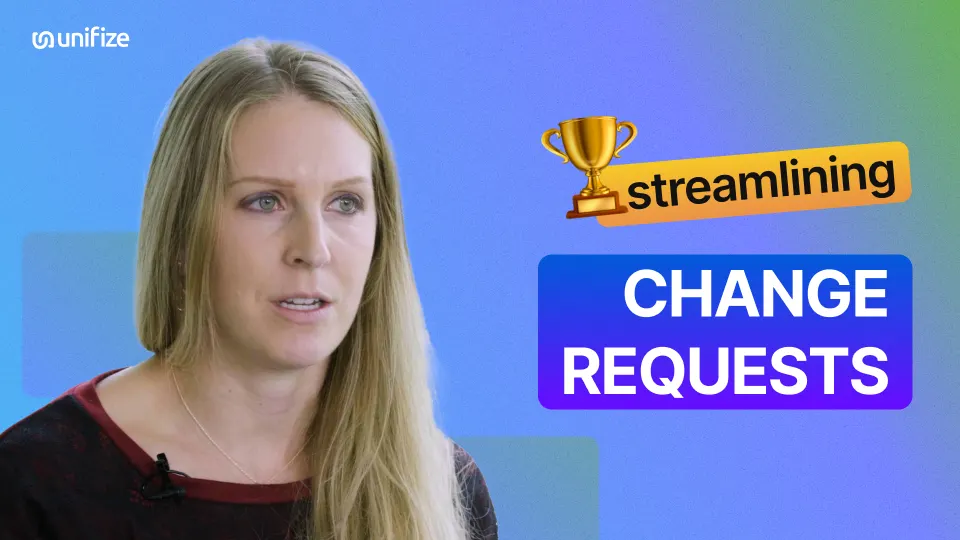 Mikala HukkaNutritional SupplementsOne change request tasks the update of every linked document
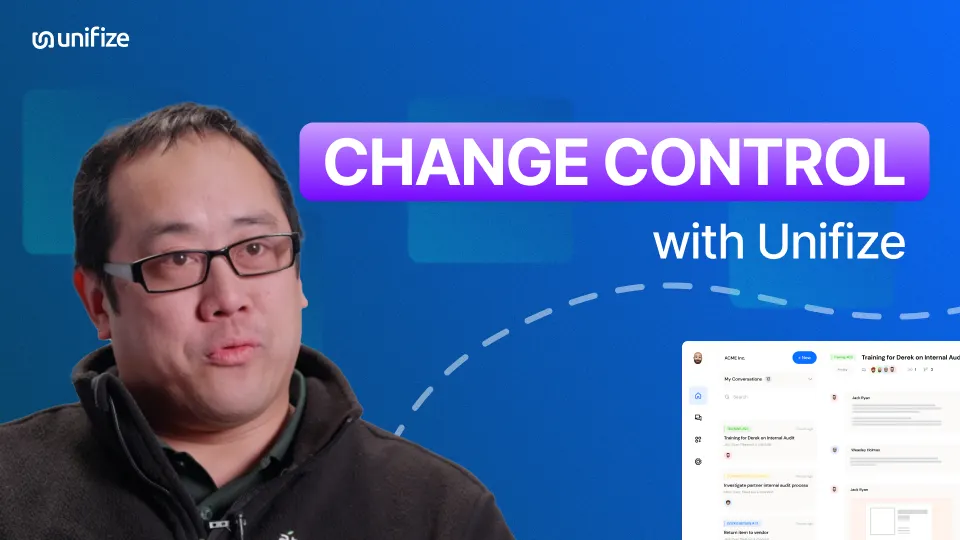 ApplechemWilson LinChange requests that lingered for months now take two weeks
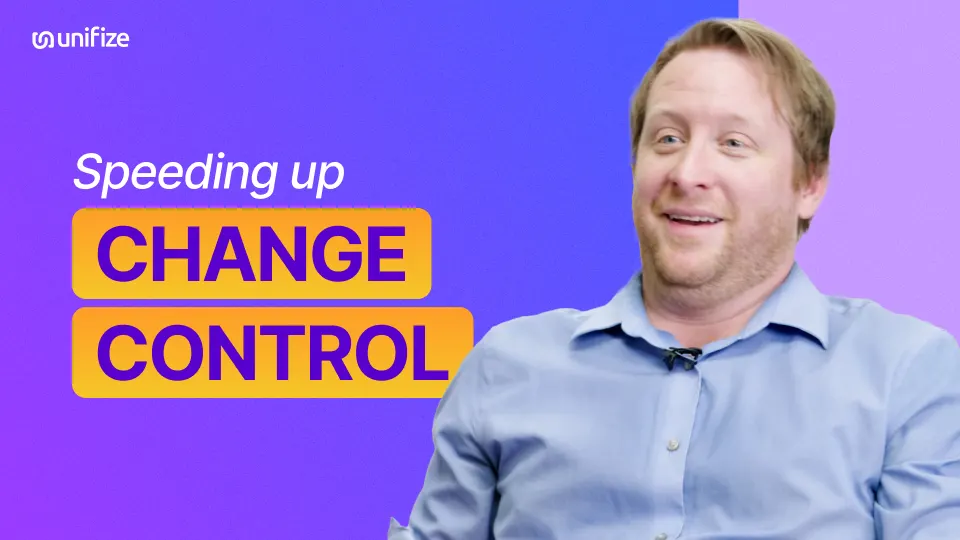 Biovation LabsJesse Kolstad, Director of QualityEach revision carries who, when and the approval
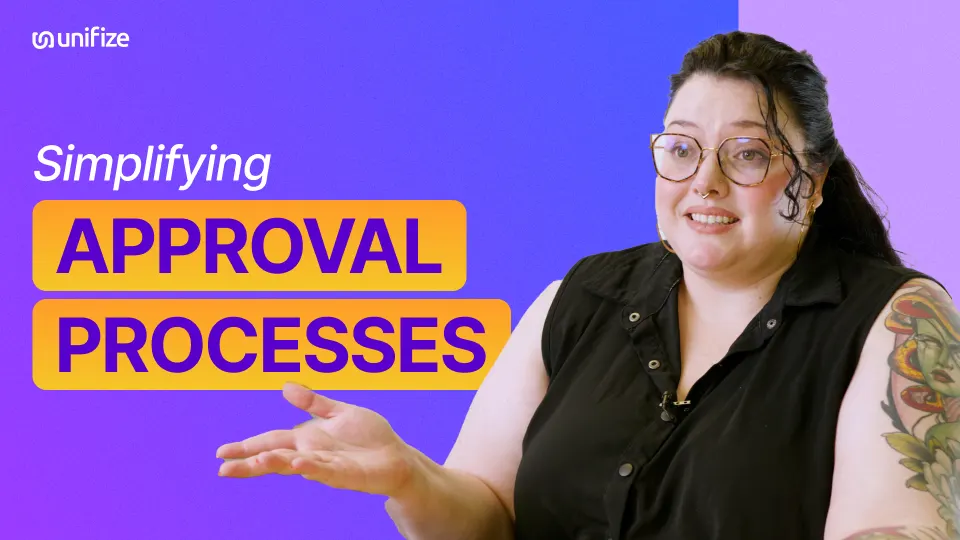 Harmonic BionicsClarissa ArcherAny approver in the group can sign, so no vacation stalls
 Harmonic BionicsClarissa ArcherApproved changes queue for document control to implement
 Harmonic BionicsMichael Hogan, Mechanical EngineerThe print sent to the vendor is the one just released
 Harmonic BionicsMichael Hogan, Mechanical EngineerNo more two-week wait on a design change approval
When a revision becomes the finding.
Each of these starts a clock, and each routes into a governed workflow, so the response is coordinated on the record it will be judged by.
Customer ECO rejection
Routes to Change Control · owned by Engineering Manager · Customer Quality
Version mismatch at site discovered
Routes to Document Control · owned by Document Control · Quality
Change-driven training cascade gap
Routes to Training Management · owned by Training Coordinator · Quality

Approve the change. Keep the reasoning.
Bring one real change, a stalled ECO or a launch-blocking spec revision, and see the decision trace on your own work in a 30-minute walkthrough.